Back in the Strathmore lecture hall — this time at the front.
Co-teaching Development Economics with Dr. Caroline Kariuki.
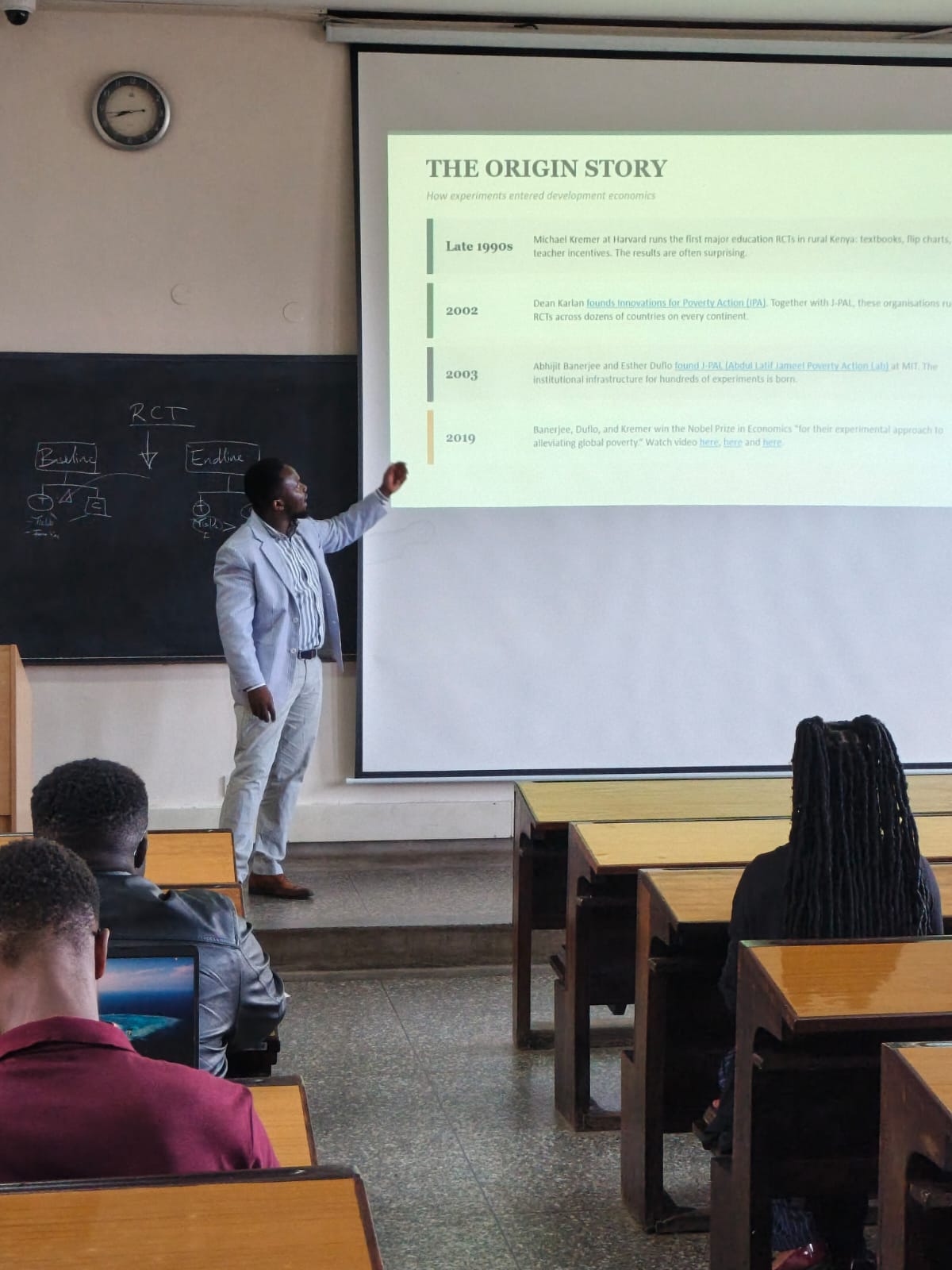
A decade ago I was the confused boy in the third row of a Strathmore lecture hall, at 11pm with too much coffee, staring at an economics problem set that felt genuinely impossible and quietly wondering whether I was cut out for this. In April 2026 I walked back into that same building. Not as a student. As a lecturer.
I come from teachers. My grandfather was a teacher. My father, for a chapter of his life, was a teacher too. The nickname my friends gave me in my twenties — "the Professor" — was a coat I wore as a joke long before it ever became a job. Co-teaching Development Economics at the Strathmore Institute of Mathematical Sciences alongside Dr. Caroline Kariuki feels less like a new ambition than a debt finally coming due.
And I did not come empty-handed. For the first time in the course's history, we introduced dedicated modules on Randomized Controlled Trials and Theories of Change — the very machinery of the evidence revolution I'd spent a decade living inside at J-PAL, TaRL, Pharo and CEGA. We refused to keep it theoretical. Students go out to live organisations — institutional partnerships with the Pharo Foundation, Food for Education and the Mastercard Foundation — to build theories of change for real institutions and watch them survive, or not survive, contact with reality.
How experiments entered development economics
The short version I tell my students on day one.
Michael Kremer at Harvard runs the first major education RCTs in rural Kenya: textbooks, flip charts, teacher incentives. The results are often surprising.
Dean Karlan founds Innovations for Poverty Action (IPA). RCTs scale across dozens of countries.
Abhijit Banerjee and Esther Duflo found J-PAL at MIT. The institutional infrastructure for hundreds of experiments is born.
Banerjee, Duflo and Kremer win the Nobel Prize in Economics for their experimental approach to alleviating global poverty.
Every lecture reminds me how far I've come, and how much of the journey was shaped by people who took the time to teach me. There's something deeply satisfying about completing that circle.